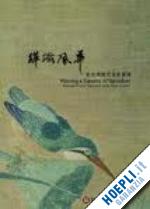
Silk tapestry is a form of textile art having a long history in China and employing specialized techniques. Unlike other weaving methods in which the vertical (warp) and horizontal (weft) threads extend back and forth completely across the loom, tapestry in China is done on a simple plain-weave loom using a technique in which the warp threads fully extend but the weft ones do not. In fact, the Chinese term for tapestry, k'o, is defined as chih-wei (or "weaving weft") in the ancient dictionary Yü-p'ien (Jade Chapters; written in 543 AD) by Ku Yeh-wang of the Liang dynasty. In other words, the formation of the pattern is based solely on changes in weaving the weft threads, with both sides of the image being the same, only reversed. Since the various adjoining colors in the weft are separate, the result is a saw-tooth gap along the edges of the forms, which is why tapestry is also known as "carved silk."
The principle behind producing a silk tapestry is quite simple, but the actual process is somewhat complex. First, all the warp threads must be fixed to the tapestry loom. Then a model in the form of a painting, for example, is placed underneath the flat and even warp threads, and a brush is used to outline the forms onto the warp. Various colored threads are prepared according to the hues in the original. Separate colors are then installed in the shuttle groove. According to the size and location of the motifs, the shuttle is moved back and forth between the warp threads. Finally, the excess is trimmed to complete the tapestry. Dozens of weaving techniques were developed over the ages to express the various aspects of the original in a tapestry of silk, including "knotting," "flinging," "connecting," "propping," "shuttle joining," "coiling," "warp joining," and "twisting colored thread." Different techniques were skillfully combined according to the original pattern with stitching added for the finer details. Sometimes even touches of ink and colors were brushed on to create certain effects, reflecting the extraordinary variety of expressions possible in the art of Chinese tapestry.
The National Palace Museum is home to a large and unique collection of tapestries, some of the most representative of which date from the Sung dynasty and are mainly on the subject of birds and flowers. The many different approaches to achieving the same goal in tapestry are comparable to intimate works of "sketching from life" in Sung dynasty painting, including aspects of composition, coloring, and expression. In the past, tapestries rarely had been displayed at the Museum, but now in this special exhibition the unique art and craft of Sung dynasty tapestry is being presented, weaving a silken tapestry of splendor in Chinese art for all audiences to understand and appreciate.