libri scuola books Fumetti ebook dvd top ten sconti 0 Carrello


Torna Indietro

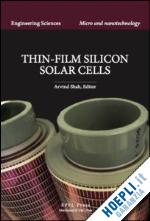
shah arvind victor (curatore) - thin-film silicon solar cells
Zoom

Thin-Film Silicon Solar Cells Photovoltaics and Large-area Electronics


Disponibilità: Normalmente disponibile in 20 giorni
A causa di problematiche nell'approvvigionamento legate alla Brexit sono possibili ritardi nelle consegne.


PREZZO
135,00 €
NICEPRICE
128,25 €
SCONTO
5%


Questo prodotto usufruisce delle SPEDIZIONI GRATIS
selezionando l'opzione Corriere Veloce in fase di ordine.


Pagabile anche con Carta della cultura giovani e del merito, 18App Bonus Cultura e Carta del Docente


Facebook Twitter Aggiungi commento


Spese Gratis

Dettagli

Genere:Libro
Lingua: Inglese
Editore:

EFPL Press

Pubblicazione: 08/2010
Edizione: 1° edizione


Note Editore

Photovoltaic technology has now developed to the extent that it is close to fulfilling the vision of a "solar-energy world," as devices based on this technology are becoming efficient, low-cost and durable.  This book provides a comprehensive treatment of thin-film silicon, a prevalent PV material, in terms of its semiconductor nature, starting out with the physical properties, but concentrating on device applications. A special emphasis is given to amorphous silicon and microcrystalline silicon as photovoltaic materials, along with a model that allows these systems to be physically described in the simplest manner possible, thus allowing the student or scientist/engineer entering the field of thin-film electronics to master a few basic concepts that are distinct from those in the field of conventional semiconductors. The main part of the book deals with solar cells and modules by illustrating the basic functioning of these devices, along with their limitations, design optimization, testing and fabrication methods. Among the manufacturing processes discussed are plasma-assisted and hot-wire deposition, sputtering, and structuring techniques.


Sommario

Introduction; Christophe Ballif

Explaining the role of thin-film silicon within PV today and tomorrow

Basic Properties of amorphous silicon (a-Si); Arvind Shah and Wolfhard Beyer

Structure of amorphous silicon

"Free" and "trapped" carriers (electrons and holes), mobility gap

Gap states

Optical absorption; optical gap and sub-bandgap absorption

Transport, conductivity and recombination

Doping of amorphous silicon layers

Hydrogen in amorphous silicon layers; Wolfhard Beyer

Alloys (with Germanium and Carbon); Wolfhard Beyer

Conclusions

Basic properties of hydrogenated µc-Si:H; Friedhelm Finger

History

Structural properties of µc-Si:H

Optical properties

Electrical properties and transport

Metastabilty -- Instabilty

Comparison with amorphous silicon

Alloys (ongoing research work)

Conclusions

Theory of solar cell devices; Arvind Shah, Corinne Droz and Martin Python

Conversion of light into electrical carriers by a semi-conductor diode

The "pn-type" or "classical" diode: Dark characteristics

The "pn-type" or "classical" diode: Properties under illumination

Limits on solar cell efficiency ?

The "pin-type" diode

Summary and conclusions of theoretical part

Tandem and multi-junction solar cells; Martin Python and Arvind Shah

Introduction; general concept

Principle of two-terminal tandem cell

Practical problems of two-terminal tandem cells

Typical tandem and multi-junction cells

Spectral response (SR) and External Quantum Efficiency (EQE) measurements

Conclusions

Module Fabrication and Performance; Horst Schade and Jean-Eric Bourée

Plasma-enhanced chemical vapor deposition (PECVD)

Hot Wire chemical vapour deposition (HWCVD)

Doped layers

Transparent conductive oxides (TCO) as contact layers

Laser scribing and series connection of cells

Module performance

Module finishing

Conclusions

Application Examples of Solar Cells; Various contributors, edited by Horst Schade and Arvind Shah

Building-integrated photovoltaics (BIPV) - aspects and examples

Stand-alone and portable applications (Oppizzi)

Indoor applications of a-Si solar cells; J. Randall

Space Applications; N. Wyrsch

Conclusions

Large-area thin-film Electronics; Nicolas Wyrsch

Thin-film transistors (TFTs) and Display Technology

Large-area imagers

Thin-film sensors on C-MOS Chips (Light imagers, Particle sensors, particle imagers)

Conclusions


Autore

Arvind V. Shah studied in Bombay, London and Zürich, receiving his Ph.D. in Applied Physics in 1968 from the Swiss Federal Institute of Technology in Zurich (ETH). He worked at the ETH until founding the Centre for Electronics Design and Technology (CEDT) at the Indian Institute of Science, Bangalore, India, in 1975. In March 1979, he was appointed professor of electronics at the University of Neuchâtel, and in 1988 began a concurrent, part-time appointment at the Swiss Federal Institute of Technology in Lausanne (EPFL). He is founder of Thin-film and Photovoltaics Laboratory at IMT Neuchâtel where he was involved with the invention of VHF plasma deposition and the pioneering work with microcrystalline silicon and “micromorph” tandem solar cells. Since 2000, he has been involved in the successful industrial transfer of technology, negotiating major licensing agreements both to start-up and established companies.


Altre Informazioni

ISBN:

9781420066746

Condizione: Nuovo
Collana: Egineering Sciences: Micro-and Nanotechnology
Dimensioni: 9.25 x 6.125 in Ø 2.25 lb
Formato: Copertina rigida
Pagine Arabe: 440


Dicono di noi