libri scuola books Fumetti ebook dvd top ten sconti 0 Carrello


Torna Indietro

simonoff jeffrey s. - smoothing methods in statistics
Zoom

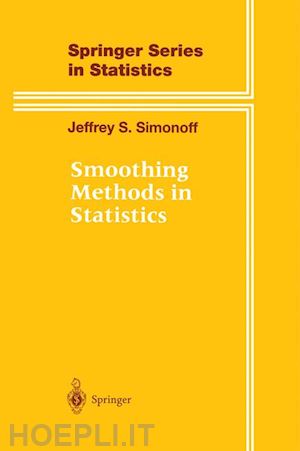
Smoothing Methods in Statistics


Disponibilità: Normalmente disponibile in 15 giorni
A causa di problematiche nell'approvvigionamento legate alla Brexit sono possibili ritardi nelle consegne.


PREZZO
124,98 €
NICEPRICE
118,73 €
SCONTO
5%


Questo prodotto usufruisce delle SPEDIZIONI GRATIS
selezionando l'opzione Corriere Veloce in fase di ordine.


Pagabile anche con Carta della cultura giovani e del merito, 18App Bonus Cultura e Carta del Docente


Facebook Twitter Aggiungi commento


Spese Gratis

Dettagli

Genere:Libro
Lingua: Inglese
Editore:

Springer

Pubblicazione: 09/2011
Edizione: Softcover reprint of the original 1st ed. 1996


Trama

The existence of high speed, inexpensive computing has made it easy to look at data in ways that were once impossible. Where once a data analyst was forced to make restrictive assumptions before beginning, the power of the computer now allows great freedom in deciding where an analysis should go. One area that has benefited greatly from this new freedom is that of non parametric density, distribution, and regression function estimation, or what are generally called smoothing methods. Most people are familiar with some smoothing methods (such as the histogram) but are unlikely to know about more recent developments that could be useful to them. If a group of experts on statistical smoothing methods are put in a room, two things are likely to happen. First, they will agree that data analysts seriously underappreciate smoothing methods. Smoothing meth­ ods use computing power to give analysts the ability to highlight unusual structure very effectively, by taking advantage of people's abilities to draw conclusions from well-designed graphics. Data analysts should take advan­ tage of this, they will argue.


Sommario

1. Introduction.- 1.1 Smoothing Methods: a Nonparametric/Parametric Compromise.- 1.2 Uses of Smoothing Methods.- 1.3 Outline of the Chapters.- Background material.- Computational issues.- Exercises.- 2. Simple Univariate Density Estimation.- 2.1 The Histogram.- 2.2 The Frequency Polygon.- 2.3 Varying the Bin Width.- 2.4 The Effectiveness of Simple Density Estimators.- Background material.- Computational issues.- Exercises.- 3. Smoother Univariate Density Estimation.- 3.1 Kernel Density Estimation.- 3.2 Problems with Kernel Density Estimation.- 3.3 Adjustments and Improvements to Kernel Density Estimation.- 3.4 Local Likelihood Estimation.- 3.5 Roughness Penalty and Spline-Based Methods.- 3.6 Comparison of Univariate Density Estimators.- Background material.- Computational issues.- Exercises.- 4. Multivariate Density Estimation.- 4.1 Simple Density Estimation Methods.- 4.2 Kernel Density Estimation.- 4.3 Other Estimators.- 4.4 Dimension Reduction and Projection Pursuit.- 4.5 The State of Multivariate Density Estimation.- Background material.- Computational issues.- Exercises.- 5. Nonparametrie Regression.- 5.1 Scatter Plot Smoothing and Kernel Regression.- 5.2 Local Polynomial Regression.- 5.3 Bandwidth Selection.- 5.4 Locally Varying the Bandwidth.- 5.5 Outliers and Autocorrelation.- 5.6 Spline Smoothing.- 5.7 Multiple Predictors and Additive Models.- 5.8 Comparing Nonparametric Regression Methods.- Background material.- Computational issues.- Exercises.- 6. Smoothing Ordered Categorical Data.- 6.1 Smoothing and Ordered Categorical Data.- 6.2 Smoothing Sparse Multinomials.- 6.3 Smoothing Sparse Contingency Tables.- 6.4 Categorical Data, Regression, and Density Estimation.- Background material.- Computational issues.- Exercises.- 7. Further Applications of Smoothing.- 7.1 Discriminant Analysis.- 7.2 Goodness-of-Fit Tests.- 7.3 Smoothing-Based Parametric Estimation.- 7.4 The Smoothed Bootstrap.- Background material.- Computational issues.- Exercises.- Appendices.- A. Descriptions of the Data Sets.- B. More on Computational Issues.- References.- Author Index.


Altre Informazioni

ISBN:

9781461284727

Condizione: Nuovo
Collana: Springer Series in Statistics
Dimensioni: 235 x 155 mm
Formato: Brossura
Illustration Notes:XII, 340 p.
Pagine Arabe: 340
Pagine Romane: xii


Dicono di noi