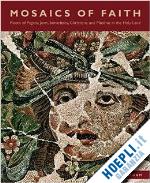
In Mosaics of Faith, Rina Talgam sets outto fill this gap by demonstrating how
mosaic art constructscultural, religious, and ethnic identities in a multiculturalsociety in eras that
shaped the visual expressions of threemonotheistic religions. An examination of the mosaics ina
pivotal region of the eastern Mediterranean sharpensand refines our understanding of societies,
their ideologies,institutions, and liturgies. Covering almost one thousandyears of mosaic
production in the area, Mosaics of Faithoffers an unprecedented view into the evolution of
floordecorations from the Hellenistic to the Roman periods, inthe transition from Roman to Early
Byzantine art, and inthe persistence of Byzantine traditions under Umayyadrule. More than any
other corpora of ancient mosaics, thosefrom the Holy Land have generated greater awareness
ofthe intricate visual dialogues between paganism, Judaism,Samaritanism, Christianity, and
Islam. Talgam examines themosaics’ formal qualities in conjunction with the religiousand
cultural contexts within which they were produced andwith which they had a profound,
multidimensional dialogue.