libri scuola books Fumetti ebook dvd top ten sconti 0 Carrello


Torna Indietro

dunbar r. i. m. (curatore); gamble clive (curatore); gowlett j. a. j. (curatore) - lucy to language
Zoom

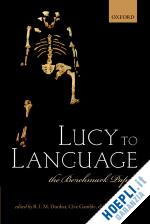
Lucy to Language The Benchmark Papers

; ;


Disponibilità: Normalmente disponibile in 20 giorni
A causa di problematiche nell'approvvigionamento legate alla Brexit sono possibili ritardi nelle consegne.


PREZZO
184,98 €
NICEPRICE
175,73 €
SCONTO
5%


Questo prodotto usufruisce delle SPEDIZIONI GRATIS
selezionando l'opzione Corriere Veloce in fase di ordine.


Pagabile anche con Carta della cultura giovani e del merito, Carta della Cultura e Carta del Docente


Facebook Twitter Aggiungi commento


Spese Gratis

Dettagli

Genere:Libro
Lingua: Inglese
Pubblicazione: 02/2014


Note Editore

The concept of the social brain has become a popular topic in the last decade and has generated interest within the research community and contributed to a wide public examination of human culture, nature, mind, and instinct, as well as aspects of social and business organisation. At its core, the hypothesis that our social life drove the dramatic enlargement of our brain, bridges the dimensions of our evolutionary history and our contemporary experience. This has been the focus of a seven-year research project funded by the British Academy, the British Academy Centenary Research Project (otherwise known as the Lucy Project). The main aim of the Lucy Project has been to explore these two axes in an integrated set of studies whose focus was to link archaeology and, in its broadest sense, evolutionary psychology, which offers powerful, new explanatory insights. This approach redresses the past contribution from archaeology towards the study of evolutionary issues and ties evolutionary psychology into the extensive historical data from the past, allowing us to escape the confined timeframe of the comparatively recent human mind. In this volume of published and new papers, the contributors explore the question of just what it is that makes us so different, and why and when these uniquely human capacities evolved.


Sommario

1 - Mind the Gap: or why we aren't just great apes
2 - The social brain and the shape of the palaeolithic
3 - The social brain hypothesis: an evolutionary perspective on the neurobiology of social behaviour
4 - Hominin cognitive evolution: identifying patterns and processes in the fossil and archaeological record
5 - The Identity Model: a theory to access visual display and hominin cognition within the Palaeolithic
6 - The longest transition or multiple revolutions? Curves and steps in the record of human origins
7 - Relationships and the social brain hypothesis: integrating evolutionary and psychological perspectives
8 - Close social relationships: an evolutionary perspective
9 - The brain opioid theory of social attachment: a review of the evidence
10 - Time as an ecological constraint
11 - Unravelling the evolutionary function of communities
12 - Fireside chat: the impact of fire on hominin socioecology
13 - Bridging the bonding gap: the transition from primates to humans
14 - Evolution of primate social systems: implications for hominin social evolution
15 - The road to modern humans: time budgets, fission-fusion sociality, kinship and the division of labour in hominin evolution
16 - The costs of being a high latitude hominin
17 - Communities on the edge of civilisation
18 - The elements of design form in Acheulean bifaces: modes, modalities, rules and language
19 - Why only humans have language
20 - Social origins: sharing, exchange, kinship
21 - Big brains, small worlds: material culture and the evolution of mind


Autore

Robin Dunbar is Professor of Evolutionary Psychology at the University of Oxford, and a Fellow of Magdalen College. His principal research interests focus on the evolution of sociality (with particular reference to primates and humans). He is best known for the social brain hypothesis, the gossip theory of language evolution, and Dunbar's Number (the limit on the number of relationships that we can manage). Clive Gamble is Professor of Archaeology at the University of Southampton. John Gowlett is Professor of Palaeolithic Archaeology at the University of Liverpool.


Altre Informazioni

ISBN:

9780199652594

Condizione: Nuovo
Dimensioni: 241 x 38.7 x 162 mm Ø 952 gr
Formato: Copertina rigida
Illustration Notes:59 in-text illustrations
Pagine Arabe: 530


Dicono di noi