libri scuola books Fumetti ebook dvd top ten sconti 0 Carrello


Torna Indietro

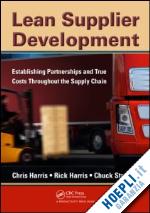
harris chris; harris rick; streeter chuck - lean supplier development
Zoom

Lean Supplier Development Establishing Partnerships and True Costs Throughout the Supply Chain

; ;


Disponibilità: Normalmente disponibile in 20 giorni
A causa di problematiche nell'approvvigionamento legate alla Brexit sono possibili ritardi nelle consegne.


PREZZO
58,98 €
NICEPRICE
56,03 €
SCONTO
5%


Questo prodotto usufruisce delle SPEDIZIONI GRATIS
selezionando l'opzione Corriere Veloce in fase di ordine.


Pagabile anche con Carta della cultura giovani e del merito, 18App Bonus Cultura e Carta del Docente


Facebook Twitter Aggiungi commento


Spese Gratis

Dettagli

Genere:Libro
Lingua: Inglese
Pubblicazione: 09/2010
Edizione: 1° edizione


Note Editore

In the global marketplace, no business is a self-contained island. No matter how effective your internal material movement, to be a future-thinking business, you must go to the next step and develop long-term supplier partnerships built on a dedication to continuous improvement and the basic concepts of Lean implementation. Lean Supplier Development: Establishing Partnerships and True Costs Throughout the Supply Chain provides step-by-step instruction on how to build partnerships of mutual improvement and success through supplier development. Offering the same advice that they have successfully applied to corporations across the globe, award-winning consultants Chris Harris, Rick Harris, and Chuck Streeter — Provide criteria on how to choose suppliers that will make good long-term partnerships Demonstrate proven methods for employing Plan for Every Part (PFEP) to link your facility to the supply base Present a true cost model that eliminates guesswork when choosing suppliers to develop Show how to develop and maintain efficient information flow all along your supply chain Use real-world examples to cover likely contingencies Provide a sample quarterly supplier review that you can adapt for your own use Lean is a journey, not a destination. It requires flexible leaders at the helm who can readily adjust to ever-changing conditions and it requires like-minded partners all along the supply chain. Finding and developing these partners is not about good fortune, it is all about an uncompromising approach to continuous improvement and the application of systematic methods that will build working partnerships that broaden your definition of what is possible


Sommario

Introduction: Why You Need This BookThe AuthorsSection I SUPPLIERS OR PARTNERS?1 Does This Stuff Really Work?IntroductionThe Interview2 The Supplier Development PhilosophyIntroductionTwo Different PhilosophiesConclusion3 Key Players in Supplier DevelopmentIntroductionThe Importance of Communication among Key PlayersKey Players in Supplier DevelopmentContinuous Improvement TeamPurchasingMaterial ControlProduct EngineeringQualityTransportationThe Role of the Key Players (The Advisory Team)Conclusion4 How to Choose a Supplier for a Long-Term PartnershipIntroductionWho Chooses the Suppliers to Develop?Attribute 1: AttitudeAttribute 2: Quality LevelAttribute 3: CapacityAttribute 4: Vital ExpertiseAttribute 5: On-Time DeliveryAttribute 6: Payment Terms (Pay on Pull)Attribute 7: Credit StandingAttribute 8: Volume CommodityAttribute 9: Flexibility to PackageAttribute 10: True Cost Model StandingConclusionSection II INTERANL OPERATIONS ESSENTIAL TO EXTERNAL SUPPLIER DEVELOPMENT5 The Importance of Internal OperationsIntroductionA Lean Supply Chain Is Built around Solid Core OperationsAn Example from Internal OperationsSolid Internal Material Movement Leads to the KnowledgeNecessary for Supplier DevelopmentConclusion6 The Plan for Every Part (PFEP)IntroductionThe Need for the Plan for Every PartThe PFEPCorrect Amount of InventoryThe Purchased Parts Supermarket BufferDetermining the Supermarket BufferHow Often Do You Receive Material?What Is the Supplier’s Quality History?What Is the Supplier’s On-Time Performance?Is the Transportation Method Reliable?What Is the Physical Distance to the Supplier?Have the Areas Using This Component Been Level Scheduled?Correctly Sizing Purchased Component InventoryPart Number 14598Part Number 14579Part Number 14556Part Number 14224Part Number 14997Part Number 14448Part Number 10805Your Actual Inventory LevelsConclusionSection III THE TRUE COST MODEL7 True Cost Thought ProcessIntroductionPiece Price versus True CostWhy Are You Sourcing/Resourcing?Cost ReductionQuality ConcernsDelivery ConcernsNew ProductsDual- or Multisourcing RequirementsProduction Capacity Concerns (Over/Under)Joint Venture Proposals/AgreementsConclusion8 Change CostIntroductionChange CostsTravel CostLost Time CostInspection CostInternal Inspection CostsExternal Inspection CostsTesting CostInternal Test CostExternal Test CostPrint Change CostTooling Cost and AmortizationInventory CostConclusion9 Ongoing CostIntroductionSupplier VisitsRepackingPay-on-Pull and ConsignmentInventory ChangeFreightCross-DockingCustoms and DutiesConclusion10 Risk CostIntroductionRisk CostsSorting (Spill Cost)Emergency TravelLost TimeExpeditingConclusion11 True Cost SourcingIntroductionBuilding the ModelPart and Supplier DataCost of Capital (Cost of Debt)Change Cost InputsTravel and Lost Time CostInspection and TestingPrint ChangesTooling and Tooling AmortizationInventoryOngoing Cost InputsTravel and Lost Time CostRepackingFreightRisk CostCost Comparison ExamplesConclusionSection IV INTERACTION BETWEEN LEAN CUSTOMERS AND PARTNERS12 Understanding the Physical Connection between Partner and CustomerIntroductionPull Signals: The Informational LinkHow to Size the Number of Pull Signals between Partner and Customer Average Daily Usage (ADU). Partner’s Time to Replenish (PTR) Transit Time (TT). Reorder Period (RP) Purchased Parts Buffer (PPB) Pull Quantity (PQ) Examples of Loop Size Calculations Reasons to Drive Down Pull Signal Loop Size Conclusion 13 Receiving Product Introduction Receiving Windows Receiving BoardsOther Methods of Interacting with SuppliersConclusion14 PackagingIntroductionStandard Pack QuantityCardboard Boxes or Plastic Returnable ContainersFive Standard SizesConclusion Section V Develop a Supplier into a Partner15 The Partner Development TeamIntroductionChoosing Your First Supplier to Develop into a PartnerForming a Partner Development TeamThe Teaching Mentality of the Partner Development TeamWho Gets the Savings?Choosing Future Suppliers to Develop Conclusion 16 The Value Stream Mapping MethodologyIntroduction The Value Stream Mapping Methodology The Product FamilyThe Current State Value Stream Map The Future State Value Stream Map 30/60/90-Day Future State Maps. A Comprehensive Work Plan Conclusion 17 The Quarterly Review ProcessIntroduction The Process Who Should Attend the Quarterly Review?The Supplier. Upper Management The Key Players The Partner Development Team Conclusion18 Supplier Development Quarterly Review Agenda Introduction Location of Meeting. Day 1: Continuous Knowledge Improvement and Networking. Day 2: Review of ProgressAdditional Notes on Quarterly ReviewsConclusion AfterwordAppendix A: The Eight Wastes and Their Relationship toSupplier Development. Introduction The Importance of Material Flow Waste 1: Overproduction. Waste 2: Waste of Making Defective Products (Rework) Waste 3: Waste of Time on Hand (Waiting) Waste 4: Processing Waste 5: Waste of Movement (Inefficient Machine and Operator Motion). Waste 6: Waste of Transportation (Inefficient Transportation of Material) Waste 7: Waste of Inventory Waste 8: Knowledge Appendix B: Sample Standard Supplier Quarterly Review Presentation


Autore

Dr. Chris Harris is a coauthor of the Shingo Prize-winning book Making Materials Flow, published by Jim Womack and the Lean Enterprise Institute. Chris has also coauthored two other books with Rick Harris, one on human resources’ role in Lean manufacturing, entitled Developing a Lean Workforce, published by Productivity Press; and the other on the vital information flow in a production facility, entitled Lean Connections, also published by Productivity Press. Chris has also written many articles on Lean production systems. Chris began his Lean manufacturing training as a team member on the assembly line at Toyota Motor Manufacturing Kentucky (TMMK).He continued his Lean training at Toyota Tsusho America in Georgetown, Kentucky andat Delphi Alternator Division in Anderson, Indiana. Chris has a doctorate in business administration from the Anderson University Falls School of Business in Indiana. He is vice president of operations for Harris Lean Systems (www.harrisleansystems.com). Rick Harris is the president of Harris Lean Systems and has been helping companies to become Lean for the past 15 years. HLS, Inc. has been instrumental in assisting companies worldwide with major cost reductions. Rick helps with the actual implementation on the shop floor and the education of the workforce. He has pioneered the reverse flow process to achieve increases in efficiency. Rick has extensive experience in developing new manufacturing layouts that facilitate one-piece flow, operator flexibility, operator engagement, first time through quality, optimum uptime, and reduced capital investment. Rick has also coauthored the two Shingo Prize-winning books Creating Continuous Flow and Making Materials Flow, published by James Womack and the Lean Enterprise Institute. Rick has also coauthored two other books with his son, Dr. Chris Harris: Developing a Lean Workforce and Lean Connections. Rick received his Lean training while serving as a manager in assembly at the Toyota plant in Georgetown, Kentucky andcontinued his Lean learning at the Toyota Tsutsumi Assembly Plant in Japan. He was a member of the start-up team at TMMK, where he gained extensive knowledge of the Toyota Production System. Prior to his Toyota experience, he spent 15 years with General Motors. Chuck Streeter is the owner of Streeter Lean Principles, LLC located in Indianapolis, Indiana. Chuck has worked with Rick Harris for over ten years, helping companies navigate through their Lean business system transformation journeys. Chuck gained much of his Lean knowledge working for companies in the automotive and electrical industries, with a majority of that being under the guidance of Rick Harris. As a Lean practitioner he has helped guide facilities to best improved, plant of the year, and corporate excellence accolades while instilling the principles of Lean in both their manufacturing and business processes. Chuck gained his formal education with a bachelor of science in management from the U.S. Air Force Academy and a master of science in systems management from the Air Force Institute of Technology. Chuck is a level III certified acquisition program manager, as well as a retired commissioned officer in the U.S. Air Force Reserve.


Altre Informazioni

ISBN:

9781439811252

Condizione: Nuovo
Dimensioni: 10 x 7 in Ø 0.88 lb
Formato: Brossura
Illustration Notes:69 b/w images and 69 Figures listes on TSForm; 29 additional ones created by TS.
Pagine Arabe: 218


Dicono di noi