libri scuola books Fumetti ebook dvd top ten sconti 0 Carrello


Torna Indietro
ARGOMENTO:  BOOKS > LETTERATURA > LINGUISTICA

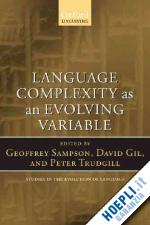
sampson geoffrey; gil david; trudgill peter - language complexity as an evolving variable
Zoom

Language Complexity as an Evolving Variable

; ;


Disponibilità: Normalmente disponibile in 10 giorni
A causa di problematiche nell'approvvigionamento legate alla Brexit sono possibili ritardi nelle consegne.


PREZZO
71,98 €
NICEPRICE
68,38 €
SCONTO
5%


Questo prodotto usufruisce delle SPEDIZIONI GRATIS
selezionando l'opzione Corriere Veloce in fase di ordine.


Pagabile anche con Carta della cultura giovani e del merito, 18App Bonus Cultura e Carta del Docente


Facebook Twitter Aggiungi commento


Spese Gratis

Dettagli

Genere:Libro
Lingua: Inglese
Pubblicazione: 02/2009


Note Editore

This book presents a challenge to the widely-held assumption that human languages are both similar and constant in their degree of complexity. For a hundred years or more the universal equality of languages has been a tenet of faith among most anthropologists and linguists. It has been frequently advanced as a corrective to the idea that some languages are at a later stage of evolution than others. It also appears to be an inevitable outcome of one of the central axioms of generative linguistic theory: that the mental architecture of language is fixed and is thus identical in all languages and that whereas genes evolve languages do not. Language Complexity as an Evolving Variable reopens the debate. Geoffrey Sampson's introductory chapter re-examines and clarifies the notion and theoretical importance of complexity in language, linguistics, cognitive science, and evolution. Eighteen distinguished scholars from all over the world then look at evidence gleaned from their own research in order to reconsider whether languages do or do not exhibit the same degrees and kinds of complexity. They examine data from a wide range of times and places. They consider the links between linguistic structure and social complexity and relate their findings to the causes and processes of language change. Their arguments are frequently controversial and provocative; their conclusions add up to an important challenge to conventional ideas about the nature of language. The authors write readably and accessibly with no recourse to unnecessary jargon. This fascinating book will appeal to all those interested in the interrelations between human nature, culture, and language.


Sommario

1 - A Linguistic Axiom Challenged
2 - How Much grammar Does it Take to Sail a Boat?
3 - On the Evolution of Complexity - Sometimes Less is More in East and Mainland Southeast Asia
4 - Testing the Assumption of Complexity Invariance: The Case of Elfdalian and Swedish
5 - Between Simplification and Complexification: Non-standard Varieties of English Around the World
6 - Implicational Hierarchies and Grammatical Complexity
7 - Sociolinguistic Typology and Complexification
8 - Linguistic Complexity: A Comprehensive Definition and Survey
9 - Complexity in Core Argument Marking and Population Size
10 - Oh noo!: A Bewilderingly Multifunctional Saramaccan Word Teaches us How a Creole Language Develops Complexity
11 - Orality Versus Literacy as a Dimension of Complexity
12 - Individual Differences in Processing complex Grammatical Structures
13 - Origin and Maintenance of Clausal Embedding Complexity
14 - Layering of Grammar: Vestiges of Protosyntax in Present-day Languages
15 - An Interview With Dan Everett
16 - Universals in Language or Cognition? Evidence from English Languae Acquisition and from Pirahã
17 - "Overall Complexity" - a Wild Goose Chase?
18 - An Efficiency Theory of Complexity and Related Phenomena
19 - Envoi


Autore

Geoffrey Sampson is Professor of Natural Language Computing at the University of Sussex. He has held positions at SOAS and LSE and at the universities of Oxford, Lancaster, and Leeds, where he was Professor of Linguistics from 1985-1990. His recent books include Empirical Linguistics and The 'Language Instinct' Debate (Continuum 2001 and 2005), and Love Songs of Early China (Shaun Tyas, 2006). David Gil is Scientific Researcher at the Max Planck Institute for Evolutionary Anthropology in Leipzig. He has held positions at UCLA, the University of Tel Aviv, and at the National University of Singapore. He is co-editor of The World Atlas of Language Structure (OUP, 2005) and author of numerous articles in journals such as Linguistic Inquiry and Linguistics. Peter Trudgill is Professor Emeritus of English Linguistics at the University of Fribourg. He previously held chairs at the Universities of Lausanne, Essex, and Reading. He is also Adjunct Professor at La Trobe University, Adjunct Professor at Agder University, and Honorary Professor at the University of East Anglia. His books include Dialects in Contact (Blackwell, 1986), Sociolinguistics (fourth edition, Penguin 2000), and New-dialect formation: on the inevitability of colonial Englishes (Edinburgh, 2004).


Altre Informazioni

ISBN:

9780199545216

Condizione: Nuovo
Collana: Studies in the Evolution of Language
Dimensioni: 242 x 24.0 x 163 mm Ø 637 gr
Formato: Copertina rigida
Illustration Notes:tables and figures
Pagine Arabe: 326


Dicono di noi