libri scuola books Fumetti ebook dvd top ten sconti 0 Carrello


Torna Indietro
ARGOMENTO:  BOOKS > INFORMATICA > TESTI GENERALI

soelvberg arne; kung david c. - information systems engineering
Zoom

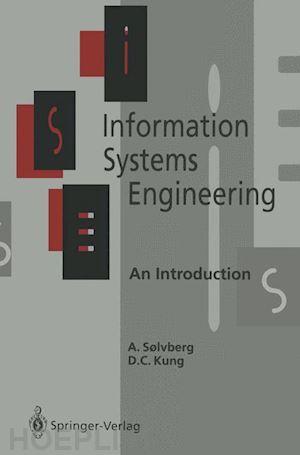
Information Systems Engineering An Introduction

;


Disponibilità: Normalmente disponibile in 15 giorni


PREZZO
108,98 €
NICEPRICE
103,53 €
SCONTO
5%


Questo prodotto usufruisce delle SPEDIZIONI GRATIS
selezionando l'opzione Corriere Veloce in fase di ordine.


Pagabile anche con Carta della cultura giovani e del merito, Carta della Cultura e Carta del Docente


Facebook Twitter Aggiungi commento


Spese Gratis

Dettagli

Genere:Libro
Lingua: Inglese
Editore:

Springer

Pubblicazione: 12/2011
Edizione: Softcover reprint of the original 1st ed. 1993


Trama

This book presents a selection of subjects which the authors deem to be important for information systems engineers. The book is intended for introductory teaching. We have tried to write the book in such a way that students with only fragmented knowledge of computers are able to read the book without too many difficulties. Students who have had only an intro­ ductory course in computer programming should be able to read most of the book. We have tried to achieve simplicity without compromising on depth in our discussions of the various aspects of information systems engineering. So it is our hope that also those who have deeper knowledge in computing may find pleasure in reading parts of the book. The writing of a textbook is a major undertaking for its authors. One is quite often forced to reexamine truisms in the subject area, and must be prepared to reevaluate one's opinions and priorities as one learns more. In particular this is so in new fields, where formalisms have been scarcely used, and where consensus has not yet emerged either on what constitutes the subject area or on how practical problems within the field shall be approached. Contemporary practice in computer applications is confronted with an increasingly complex world, both in a technical sense and in the complexity of problems that are solved by computer.


Sommario

1. Introduction.- 1.1 Two Information System Examples.- 1.2 Information Systems Modeling.- 1.3 Contemporary Changes in System Development Practices.- 1.4 System Development Activities.- 1.5 The Methods Problem in Information Systems Engineering.- 1.6 Information Systems Analysis Approaches.- 2. Structured Analysis and Design.- 2.1 Structured Analysis.- 2.2 Structured Design.- 2.3 User Interfaces.- Exercises.- 3. Software Design.- 3.1 A Review of Software Terminology.- 3.2 Software Design for Maintainability.- 3.3 Program Structures for Hierarchical Files.- 3.4 The Object Oriented Approach.- 3.5 Principles for Creating Software with Acceptable Response Times.- 3.6 Workload Analysis of Software Design Specifications.- Exercises.- 4. Database Design.- 4.1 Files and Databases.- 4.2 Data Model Alternatives.- 4.3 Issues in Database Physical Design.- 4.4 Database Design Constrained by Traffic Load Estimates.- Exercises.- 5. Rule Modeling.- 5.1 Rule Formulation.- 5.2 Simple Rule Modeling Tools.- 5.3 Decision Trees.- 5.4 Decision Tables.- 5.5 Structured English.- 5.6 Comparison of Decision Trees, Decision Tables and Structured English.- 5.7 Process Logic and Expert Systems.- 5.8 An Introduction to Logical Inference.- Exercises.- 6. Information Systems Evolution: The Software Aspect.- 6.1 The Role of Standard Software in Information Systems Evolution.- 6.2 The Installation of Software Systems in Organizations.- 6.3 Evolutionary Behavior of Large Software Systems.- Exercises.- 7. Managing Information Systems Development Projects.- 7.1 Project Selection: The Master Plan.- 7.2 The Project Life Cycle.- 7.3 Project Evaluation and Control.- 7.4 The Information System Development Organization.- Exercises.- 8. Information System Support for Information System Development.- 8.1 Contemporary Environments for Supporting System Development.- 8.2 The Functional Properties of Support Systems for Information Systems Engineering (lSE-systems).- 8.3 A Database for Supporting Information Systems Engineering.- 8.4 Information Systems Configuration Management.- Exercises.- 9. Engineering Design Principles for Unsurveyable Systems.- 9.1 The Engineering Design Process.- 9.2 Properties of Unsurveyable Systems.- 9.3 Development of Non-constructive Systems.- Exercises.- 10. Information and Information Systems.- 10.1 Relationships Between Knowledge and Information.- 10.2 Ways of Obtaining Knowledge.- 10.3 Formal and Informal Information.- 10.4 The Information System and Its Environment.- 10.5 Information Systems Viewed as Production Organizations.- 10.6 Self-Referential Information Systems.- Exercises.- 11. Three Domains of Information Systems Modeling — and the Object-Oriented Approach.- 11.1 Subject Domain Modeling.- 11.2 Interaction Domain Modeling.- 11.3 Implementation Domain Modeling.- 11.4 The Basic Concepts of the Object-Oriented Approach.- 11.5 Object-Oriented Analysis.- 11.6 Object-Oriented Design.- 11.7 Object-Oriented, Function-Oriented, and Data-Oriented Approaches.- Exercises.- 12. Model Integration with Executable Specifications.- 12.1 Constructivity in Information Systems Modeling.- 12.2 The PPP Approach.- 12.3 The Problem of Removing Irrelevant Specificational Detail.- 12.4 A Simple Method for Abstracting Away Modeling Detail..- Exercises.- 13. An Example of Comparing Information Systems Analysis Approaches.- 13.1 The Example: A One-Bit Window Protocol.- 13.2 Object-Oriented Analysis of the Communication Protocol.- 13.3 The Communication Protocol Modeled as a State-Transition Machine.- 13.4 Stimulus-Response Analysis of the CommunicationProtocolExercises 473.- Exercises.- 14. Formal Modeling Approaches.- 14.1 The Set-Theoretic Approach to Information Modeling.- 14.2 The Semantic Network Approach to Information Modeling.- 14.3 The ACM/PCM Modeling Approach.- 14.4 Petri Nets.- 14.5 The Behavior Network Model.- 14.6 The Retail Company Example.- 14.7 Simulation in the Behavior Network.- 14.8 Derivation of External Systems Properties Using Path Analysis.- 14.9 The Temporal Dimension ofInformation System Modeling.- 14.10 Modeling With Explicit Time Reference.- 14.11 Modeling With Topological Time.- Exercises.- References.


Altre Informazioni

ISBN:

9783642780035

Condizione: Nuovo
Dimensioni: 235 x 155 mm
Formato: Brossura
Illustration Notes:XV, 540 p.
Pagine Arabe: 540
Pagine Romane: xv


Dicono di noi