Questo prodotto usufruisce delle SPEDIZIONI GRATIS
selezionando l'opzione Corriere Veloce in fase di ordine.
Pagabile anche con Carta della cultura giovani e del merito, 18App Bonus Cultura e Carta del Docente
Your one indispensable guide to IFRS compliance
International Financial Reporting Standards (IFRS), originally known as International Accounting Standards (IAS), have existed since the mid–1970s but have received significant attention from standard–setters, preparers, and users of financial statements in recent years. The IASB's restructuring in 2001 introduced due process procedures that conveyed added credibility upon the standards it promulgated, while other events, such as the epidemic of financial reporting frauds in the late 1990s and early 2000s, helped foster the perception that the diversity of national financial reporting standards needed to be addressed and resolved to ease the burden of investors and facilitate the international flow of capital. Seminal events included the qualified acceptance of IFRS by the International Organization of Securities Commissions (IOSCO); the mandate for all European Union chartered publicly held companies to report consolidated financial statements under IFRS beginning in 2005; and the US Securities and Exchange Commission (SEC) decision to excuse foreign private issuers using IFRS from the requirement to reconcile financial statements to US GAAP basis, and possible granting of permission to domestic filers to drop US GAAP in favor of IFRS. As other major nations either formally adopt IFRS (e.g., China) or heavily incorporate them into nominally national GAAP (e.g., Australia), and as several major private sector standard–setters (in the US and UK, most notably) have committed to "converge" to IFRS, the importance of IFRS to the future of financial reporting is assured.
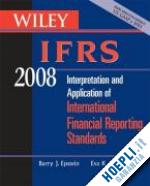
Wiley IFRS 2008 is the comprehensive source for guidance in applying IFRS to complex, real–world situations, and is equally valuable for preparers, auditors, and users of financial reports. To facilitate the reader's understanding, examples created to explain particular IFRS requirements and selections from actual published financial statements are copiously provided throughout the book, illustrating all key concepts. Also included in this edition are a revised, comprehensive disclosure checklist; an updated, detailed comparison between US GAAP and IFRS, keyed to chapter topics; and discussions of major ongoing IASB projects that may have significant impact on readers' responsibilities over the coming year, including IASB's controversial attempt to define IFRS for smaller companies.
The revised 2008 edition addresses important and complex requirements such as those pertaining to the accounting for:
Financial instruments
Loss contingencies
Business combinations
Employee benefits
Foreign currency based transactions
The 2008 edition continues detailed coverage of all previously issued IAS and IFRS standards and SIC and IFRIC interpretations, including the complex but important financial instruments guidance of IAS 32, IAS 39, and IFRS 7. New examples have been added to every chapter. Other complex areas of financial reporting receiving expansive coverage include:
Leases
Revenue recognition
Employee benefits
Revised requirements for form and content of financial statements
Impairment of assets
Agriculture
Insurance
Extraction of minerals
Chapter2. Statement of Financial Position.
Chapter 3. Statements of Income, Comprehensive Income, and Changes in Equity.
Chapter 4. Statements of Cash Flows.
Chapter 5. Cash, Receivables, and Financial Instruments.
Chapter 6. Inventory.
Chapter 7. Revenue Recognition, Including Construction Contracts.
Chapter 8. Property,Plant, and Equipment.
Chapter 9. Intangible Assets.
Chapter 10. Interests in Financial Instruments, Associates, Joint Ventures, and Investment Property.
Chapter 11. Business Combinations and Consolidated Financial Statements.
Chapter 12. Current Liabilities, Provisions, Contingencies, and Evens After the Reporting Period.
Chapter 13. Financial Instruments–Long–Term Debt.
Chapter 14. Leases.
Chapter 15. Income Taxes.
Chapter 16. Employee Benefits.
Chapter 17. Shareholders' Equity.
Chapter 18. Earnings Per Share.
Chapter 19. Interim Financial Reporting.
Chapter 20. Operating Segments.
Chapter 21. Changes in Accounting Policies and Estimates, and Corrections of Errors.
Chapter 22. Foreign Currency.
Chapter 23. Related–Party Disclosures.
Chapter 24. Specialized Industry Accounting.
Chapter 25. Inflation and Hyperinflation.
Chapter 26. Government Grants.
Chapter 27. First–Time Adoption of International Financial Reporting Standards.
Appendix A. Disclosure Checklist.
Appendix B. Illustrative Financial Statement Presented under IFRS.
Appendix C. Comparison of IFRS and US GAAP.
Index.


Il sito utilizza cookie ed altri strumenti di tracciamento che raccolgono informazioni dal dispositivo dell’utente. Oltre ai cookie tecnici ed analitici aggregati, strettamente necessari per il funzionamento di questo sito web, previo consenso dell’utente possono essere installati cookie di profilazione e marketing e cookie dei social media. Cliccando su “Accetto tutti i cookie” saranno attivate tutte le categorie di cookie. Per accettare solo deterninate categorie di cookie, cliccare invece su “Impostazioni cookie”. Chiudendo il banner o continuando a navigare saranno installati solo cookie tecnici. Per maggiori dettagli, consultare la Cookie Policy.