Questo prodotto usufruisce delle SPEDIZIONI GRATIS
selezionando l'opzione Corriere Veloce in fase di ordine.
Pagabile anche con Carta della cultura giovani e del merito, Carta della Cultura e Carta del Docente
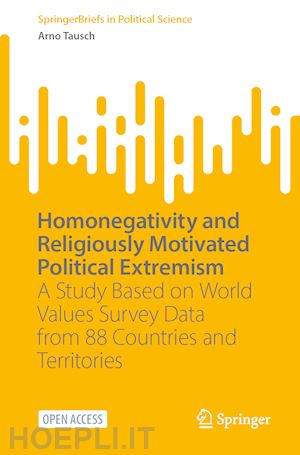
This open access book describes the world’s increasingly multicultural societies face the problem that more and more diverse lifestyles (LGBTQIA+ communities) are not universally accepted, and that today, in addition to xenophobia, racism and anti-Semitism, there is substantial homonegativity. This book explores this issue, reviews the empirical literature on the subject and provides new empirically based evidence on a global and European scale. Based on an analysis of The World Values Survey using the statistical software SPSS, it provides a scientifically sound answer to the question of which social groups in Europe and around the globe are more homophobic and which are less, together with insights into the multivariate relationships between homonegativity and religiously motivated political extremism. The extensive and representative statistical samples allow cautious conclusions to be drawn for smaller religious groups in the European Union and other countries around the world.
Chapter 1. Introduction: Setting the Scene.- Chapter 2. The global clash of civilizations on homosexuality and the threat of hate crimes against LGBTQ+ communities as documented by international organizations and NGOs.- Chapter 3. Using World Vaues Survey and European Social Survey data on homosexuality and homonegativity: the comparative evidence from the social sciences.- Chapter 4. Methodology and Data for our new analysis.- Chapter 5. Results from the bivariate and multivariate analysis of homonegativity.- Chapter 6. The potential for violence against homosexuals and strategies of advancing tolerant gender social norms and democracy.-Chapter 7. Perspectives and conclusions from this study.
Arno Tausch is currently a Visiting Professor of Political Studies and Governance, the University of the Free State, Bloemfontein, South Africa (as of May 1, 2022). He is also an Adjunct Professor of Political Science at Innsbruck University, Department of Political Science, Innsbruck University, Austria (since 1988).


Il sito utilizza cookie ed altri strumenti di tracciamento che raccolgono informazioni dal dispositivo dell’utente. Oltre ai cookie tecnici ed analitici aggregati, strettamente necessari per il funzionamento di questo sito web, previo consenso dell’utente possono essere installati cookie di profilazione e marketing e cookie dei social media. Cliccando su “Accetto tutti i cookie” saranno attivate tutte le categorie di cookie. Per accettare solo deterninate categorie di cookie, cliccare invece su “Impostazioni cookie”. Chiudendo il banner o continuando a navigare saranno installati solo cookie tecnici. Per maggiori dettagli, consultare la Cookie Policy.