libri scuola books Fumetti ebook dvd top ten sconti 0 Carrello


Torna Indietro

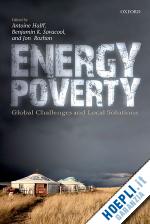
halff antoine (curatore); sovacool benjamin k. (curatore); rozhon jon (curatore) - energy poverty
Zoom

Energy Poverty Global Challenges and Local Solutions

; ;


Disponibilità: Normalmente disponibile in 20 giorni
A causa di problematiche nell'approvvigionamento legate alla Brexit sono possibili ritardi nelle consegne.


PREZZO
191,98 €
NICEPRICE
182,38 €
SCONTO
5%


Questo prodotto usufruisce delle SPEDIZIONI GRATIS
selezionando l'opzione Corriere Veloce in fase di ordine.


Pagabile anche con Carta della cultura giovani e del merito, 18App Bonus Cultura e Carta del Docente


Facebook Twitter Aggiungi commento


Spese Gratis

Dettagli

Genere:Libro
Lingua: Inglese
Pubblicazione: 11/2014


Note Editore

This edited volume looks at energy poverty, an issue whose pivotal role in the fight for human development is only now being recognised by policymakers. Nearly one quarter of humanity still lacks access to electricity. Close to one third rely on traditional fuels like firewood and cow dung for cooking, at great cost to their health and welfare. While most prevalent in parts of Africa and Asia, energy poverty is a global problem which concerns us all. This book, which brings together economists, policymakers, entrepreneurs, and other practitioners from all over the world, is dedicated to a single goal: finding a solution to this haunting problem. It is part history, part economics, part political analysis, part business case review, and part field handbook. Part One focuses on defining and measuring the problem and benchmarking progress in solving it, an obvious prerequisite to any successful energy-access policy. Part Two reviews past and current energy access programs, with an eye towards finding out what worked and what didn't and what can be replicated elsewhere. These case reviews are told as seen on the ground - China's experience by top Chinese officials and Africa's by African regulators and scholars. Based in part on those cases, the book's last, more forward-looking section aims to present practitioners with a tool kit, a menu of options to speed up their efforts. The energy access agenda is gaining traction at a time of rising concerns about climate change and resource constraints. This book shows that bringing modern energy to those who lack it not just a moral imperative, but will likely benefit the world as a whole without harming the environment or unduly stretching finite resources.


Sommario

1 - Achieving Energy For All Will Not Cost The Earth
2 - Defining, Measuring, and Tackling Energy Poverty
3 - The Development Impact of Energy Access
4 - The World Bank's Perspective on Energy Access
5 - Health Benefits from Energy Access in LMICs: Mechanisms, Impacts, and Policy Opportunities
6 - Energy Poverty and Public Health: Impacts of Solid Cookfuel
7 - Energy and Gender
8 - Beyond Basic Access: The Scale of Investment Required for Universal Energy Access
9 - Energy and Water: A Critical Linkage
10 - Striving Towards Development: China's Energy Poverty Alleviation Efforts
11 - Indian Approaches to Energy Access
12 - Modern Energy Services to Low Income Households in Brazil: Lessons Learned and Challenges Ahead
13 - Energy Poverty in the Middle East and North Africa
14 - Energy Poverty in Sub-Saharan Africa: Poverty Amidst Abundance
15 - Global Energy Subsidies: Scale, Opportunity Costs, and Barriers to Reform
16 - Is Small Beautiful?
17 - Expanding Energy Access: An Assessment of U.S. Policy
18 - The Energy Access Practitioner Network
19 - The Energy Plus Approach: Reducing Poverty with Productive Uses of Energy
20 - Unlocking Financial Resources
21 - Alleviating Energy Poverty in Africa: A Story of Leapfrogging, Localizing, and Fast-Tracking


Autore

Antoine Halff is a senior official of the International Energy Agency, the head of its oil unit, and the editor of its authoritative monthly publication, the Oil Market Report. He has spent the last 20 years of his career focusing on energy issues in a series of positions spanning the worlds of government, finance, consulting, higher education, and the media, including New York bureau chief of famed newsletter Petroleum Intelligence Weekly, director of global energy for political-risk consultancy Eurasia Group, deputy head of research at Newedge, one of the world's top brokerages, and lead economist with the US Department of Energy's research arm, the Energy Information Administration. He has also taught courses on the Geopolitics of Energy and related topics at Columbia University's School of International and Public Affairs. He was born and educated in Paris and has lived and worked in Paris, Seoul, New York, and Washington, DC. Jon Rozhon is Senior Researcher at the Canadian Energy Research Institute (CERI) and President of Oak Leaf Energy Training. He is Editor-in-Chief of the CERI journal, Geopolitics of Energy and author of numerous studies in areas as diverse as electric power, energy investment, and natural gas vehicles. He was Lecturer in English at the Gifu University for Foreign Languages for 15 years and has spent the past six years at CERI. In 2010, he started Oak Leaf Energy Training, which has provided training for over 100 corporations and government agencies. He holds an MA in English from Lakehead University and an MBA from McGill. Benjamin K. Sovacool is Director of the Danish Center for Energy Technology at AU-Herning and a Professor of Business and Social Sciences at Aarhus University. He is also Associate Professor of Law at Vermont Law School and Director of the Energy Security and Justice Program at their Institute for Energy and the Environment, as well as the Editor-in-Chief of the journal Energy Research and Social Science. He works as a researcher and consultant on renewable energy and energy efficiency, the politics of large-scale energy infrastructure, designing public policy to improve energy security and access to electricity, and building adaptive capacity to the consequences of climate change. He is a Contributing Author to the Intergovernmental Panel on Climate Change's (IPCC) forthcoming Fifth Assessment (AR5). He has consulted for the Asian Development Bank, United Nations Development Program, and United Nations Economic and Social Commission for Asia and the Pacific.


Altre Informazioni

ISBN:

9780199682362

Condizione: Nuovo
Dimensioni: 240 x 30.0 x 162 mm Ø 862 gr
Formato: Copertina rigida
Illustration Notes:83 Figures, 70 Tables, 6 Boxes
Pagine Arabe: 476


Dicono di noi