Questo prodotto usufruisce delle SPEDIZIONI GRATIS
selezionando l'opzione Corriere Veloce in fase di ordine.
Pagabile anche con Carta della cultura giovani e del merito, Carta della Cultura e Carta del Docente
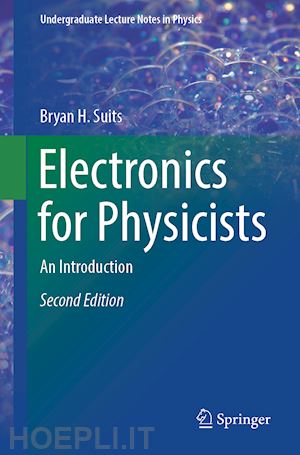
This book provides undergraduate physics majors and students of related sciences with a sound understanding of basic electronics and how it is used in the physical sciences. While today few science students go on to careers that demand an ability to design and build electronic circuits, many will use and rely on electronics. As scientists, they will require an appropriate level of fundamental knowledge that enables them, for example, to understand what electronic equipment is doing, to correctly interpret the measurements obtained, and to appreciate the numerous links between electronics and how it is practiced and other areas of science. Discussing electronics in the broader context and from the point of view of the scientist, this book is intended for students who are not planning to become electronics specialists but who will use electronics. It has been written in a relatively informal style and includes many detailed examples, as well assome “outside the box” material, including some ideas from quantum computing, to inspire thought and creativity. A selection of relevant exercises is included at the end of each chapter.
In the updated second edition, some sections are clarified and end-of-chapter problems are added. It includes an additional chapter on quantum logic/computing
The Basics.- Additional Theorems.- Complex Impedances.- More on Capacitors and Inductors.- The Laplace Transform.- Diodes.- FETs.- Bipolar Junction Transistors.- More on Amplifiers.- The Ideal Op-Amp.- Non-linear Uses of Op-Amps.- Digital I.- Digital II.- Calculators and Computers.
Bryan H. Suits has been a Professor at the Department of Physics at Michigan Technological University (MTU) since 1985, where he has taught physics courses at all levels. He obtained a BA in Physics from Carleton College in Northfield, Mn, and his MS and PhD in Physics at the University of Illinois, Champaign-Urbana. His research focuses on the use of radiofrequency spectroscopies, specifically nuclear magnetic resonance (NMR) and nuclear quadrupole resonance (NQR), as tools to study problems in materials and solid-state physics. His most recent research concentrates on the development of equipment and techniques for non-invasive materials detection techniques for use in the field.


Il sito utilizza cookie ed altri strumenti di tracciamento che raccolgono informazioni dal dispositivo dell’utente. Oltre ai cookie tecnici ed analitici aggregati, strettamente necessari per il funzionamento di questo sito web, previo consenso dell’utente possono essere installati cookie di profilazione e marketing e cookie dei social media. Cliccando su “Accetto tutti i cookie” saranno attivate tutte le categorie di cookie. Per accettare solo deterninate categorie di cookie, cliccare invece su “Impostazioni cookie”. Chiudendo il banner o continuando a navigare saranno installati solo cookie tecnici. Per maggiori dettagli, consultare la Cookie Policy.