Questo prodotto usufruisce delle SPEDIZIONI GRATIS
selezionando l'opzione Corriere Veloce in fase di ordine.
Pagabile anche con Carta della cultura giovani e del merito, 18App Bonus Cultura e Carta del Docente
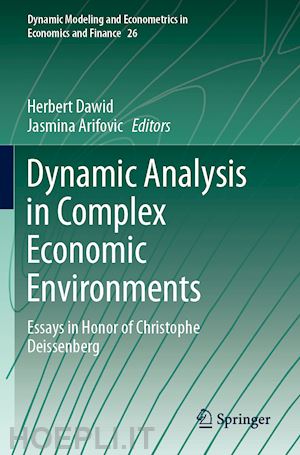
This book analyses decision-making in dynamic economic environments. By applying a wide range of methodological approaches, combining both analytical and computational methods, the contributors examine various aspects of optimal firm behaviour and relevant policy areas. Topics covered include optimal control, dynamic games, economic decision-making, and applications in finance and economics, as well as policy implications in areas such as pollution regulation.
This book is dedicated to Christophe Deissenberg, a well-known and distinguished scholar of economic dynamics and computational economics. It appeals to academics in the areas of optimal control, dynamic games and computational economics as well as to decision-makers working in policy domains such as environmental policy.
Chapter 1 “Introduction” by Herbert Dawid and Jasmina Arifovic.- Chapter 2. “Cross-bidding in eBay-like Environments” by Francisco Alvarez and Marcello Sartarelli.- Chapter 3. “Risk–Reward Ratio Optimisation (Revisited)” by Manfred Gilli and Enrico Schumann.- Chapter 4. “Optimal Investment-Consumption Decisions with Partially Observed Inflation: A DiscreteTime Formulation” by Alain Bensoussan and Suresh P. Sethi.- Chapter 5. “Dynamic Games of Common-Property Resource Exploitation when Self-Image Matters” by Ngo van Long.- Chapter 6. “The Effects of Political Short-termism on Transitions Induced by Pollution Regulations” by Giovanni Di Bartolomeo, Enrico Saltari and Willi Semmler.- Chapter 7. “Capital Control, Exchange Rate Regime and Monetary Policy: Indeterminacy and Bifurcation” by William A. Barnett and Jingxian Hu.- Chapter 8. “A Multi-Agent Methodology to Assess the Effectiveness of Alternative Systemic-Risk
Adjusted Capital Requirements” by Andrea Gurgoneand Giulia Iori.- Chapter 9. “The Role of (De-)Centralized Wage Setting for Industry Dynamics and Economic Growth: An Agent-Based Analysis with the Eurace@Unibi Model” by Herbert Dawid, Philipp Harting and Michael Neugart.- Chapter 10. “Oracle & Interactive Computations, Post-Turing Thesis & Man-Machine Interactions” by K.Vela Velupillai .


Il sito utilizza cookie ed altri strumenti di tracciamento che raccolgono informazioni dal dispositivo dell’utente. Oltre ai cookie tecnici ed analitici aggregati, strettamente necessari per il funzionamento di questo sito web, previo consenso dell’utente possono essere installati cookie di profilazione e marketing e cookie dei social media. Cliccando su “Accetto tutti i cookie” saranno attivate tutte le categorie di cookie. Per accettare solo deterninate categorie di cookie, cliccare invece su “Impostazioni cookie”. Chiudendo il banner o continuando a navigare saranno installati solo cookie tecnici. Per maggiori dettagli, consultare la Cookie Policy.