Questo prodotto usufruisce delle SPEDIZIONI GRATIS
selezionando l'opzione Corriere Veloce in fase di ordine.
Pagabile anche con Carta della cultura giovani e del merito, Carta della Cultura e Carta del Docente
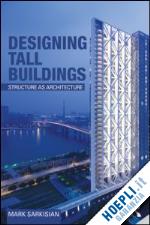
The first of its kind, Designing Tall Buildings is an accessible reference that guides you through the fundamental principles of designing high-rises. Each chapter focuses on one theme central to tall-building design, giving you a comprehensive overview of the related architecture and structural engineering concepts. Mark P. Sarkisian provides clear definitions of technical terms and introduces important equations, to help you gradually develop your knowledge. Later chapters allow you to explore more complex applications, such as biomimicry. Projects drawn from Skidmore, Owings and Merrill’s vast catalog of built high-rises, many of which Sarkisian designed, demonstrate these concepts.
This book advises you to consider the influence of a particular site’s geology, wind conditions, and seismicity. Using this contextual knowledge and analysis, you can determine what types of structural solutions are best suited for a tower on that site. You can then conceptualize and devise efficient structural systems that are not only safe, but also constructible and economical. Sarkisian also addresses the influence of nature in design, urging you to integrate structure and architecture for buildings of superior performance, sustainability, and aesthetic excellence.
Foreword Introduction 1. Perspective 2. Site 2.1 Wind 2.2 Seismicity 2.3 Soils 3. Forces 3.1 Code-Defined Gravity Loads 3.2 Code-Defined Vertical Force Distribution for Wind 3.3 Code-Defined Vertical Force Distribution for Seismic 3.4 Gravity Load Distribution and Takedowns 3.5 Load Combinations 3.6 Design Axial, Shear, and Bending Moments 4. Language 4.1 Force Flow 4.2 Structural Framing Plans 4.3 Structural System Elevations 5. Attributes 5.1 Strength 5.2 Serviceability 6. Characteristics 6.1 Dynamic Properties 6.2 Aerodynamics 6.3 Placement of Structural Materials 6.4 Floor-To-Floor Heights 6.5 Aspect Ratios 7. Systems 7.1 Material Quantities 7.2 Practical Limits of Structural Systems 7.3 Major System Details 8. Nature 8.1 Screen Frames 8.2 Cores and Pre-stressed Frames 8.3 The Infinity Column 8.4 Growth Patterns 8.5 The Stayed Mast 8.6 The Perfect Tube 8.7 The Logarithmic Spiral 9. Mechanisms 9.1 Unnatural Behavior 9.2 Conventional Beam-To-Column Tests 9.3 Wood Dowels and Steel Pins 9.4 Pinned Joints 9.5 The Pin-Fuse Joint 9.6 Managing Large Seismic Movements 9.7 Combining Natural Forms and Mechanisms 10. Environment 10.1 Automobile Analogy 10.2 Conventional vs. Enhanced Seismic Systems 10.3 Reduction of Seismic Mass 10.4 The Environment Analysis Tool 10.5 Reducing Environmental Impact through Advanced Organic Theories


Il sito utilizza cookie ed altri strumenti di tracciamento che raccolgono informazioni dal dispositivo dell’utente. Oltre ai cookie tecnici ed analitici aggregati, strettamente necessari per il funzionamento di questo sito web, previo consenso dell’utente possono essere installati cookie di profilazione e marketing e cookie dei social media. Cliccando su “Accetto tutti i cookie” saranno attivate tutte le categorie di cookie. Per accettare solo deterninate categorie di cookie, cliccare invece su “Impostazioni cookie”. Chiudendo il banner o continuando a navigare saranno installati solo cookie tecnici. Per maggiori dettagli, consultare la Cookie Policy.