libri scuola books Fumetti ebook dvd top ten sconti 0 Carrello


Torna Indietro
ARGOMENTO:  BOOKS > ASTRONOMIA > TESTI GENERALI

wheeler j. craig - cosmic catastrophes
Zoom

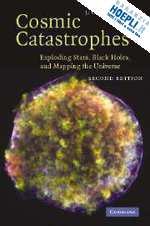
Cosmic Catastrophes Exploding Stars, Black Holes, and Mapping the Universe


5 stelle su 5 1 recensioni presenti


Disponibilità: Normalmente disponibile in 20 giorni
A causa di problematiche nell'approvvigionamento legate alla Brexit sono possibili ritardi nelle consegne.


PREZZO
68,98 €
NICEPRICE
65,53 €
SCONTO
5%


Questo prodotto usufruisce delle SPEDIZIONI GRATIS
selezionando l'opzione Corriere Veloce in fase di ordine.


Pagabile anche con Carta della cultura giovani e del merito, 18App Bonus Cultura e Carta del Docente


Facebook Twitter Aggiungi commento


Spese Gratis

Dettagli

Genere:Libro
Lingua: Inglese
Pubblicazione: 01/2007
Edizione: Edizione rivisitata, 2° edizione


Trama

In this tour de force of the ultimate and extreme in the universe, renowned astrophysicist and author J. Craig Wheeler takes readers on a breathtaking journey to supernovae, black holes, gamma-ray bursts and adventures in hyperspace. This is no far-fetched science fiction tale, but an enthusiastic exploration of ideas at the cutting edge of science. 33 halftones.


Note Editore

From supernovae and gamma-ray bursts to the accelerating Universe, this is an exploration of the intellectual threads that lead to some of the most exciting ideas in modern astrophysics and cosmology. This fully updated second edition incorporates new material on binary stars, black holes, gamma-ray bursts, worm-holes, quantum gravity and string theory. It covers the origins of stars and their evolution, the mechanisms responsible for supernovae, and their progeny, neutron stars and black holes. It examines the theoretical ideas behind black holes and their manifestation in observational astronomy and presents neutron stars in all their variety known today. This book also covers the physics of the twentieth century, discussing quantum theory and Einstein's gravity, how these two theories collide, and the prospects for their reconciliation in the twenty-first century. This will be essential reading for undergraduate students in astronomy and astrophysics, and an excellent, accessible introduction for a wider audience.


Sommario

Preface; 1. Setting the stage: star formation and hydrogen burning in single stars; 2. Stellar death: the inexorable grip of gravity; 3. Dancing with stars: binary stellar evolution; 4. Accretion disks: flat stars; 5. White Dwarfs: quantum dots; 6. Supernovae: stellar catastrophes; 7. Supernova 1987A: lessons and enigmas; 8. Neutron stars: atoms with attitude; 9. Black holes in theory: into the abyss; 10. Black holes in fact: exploring the reality; 11. Gamma-ray bursts, black holes and the universe: long, long ago and far, far away; 12. Supernovae and the universe; 13. Worm holes and time machines: tunnels in space and time; 14. Beyond: the frontiers; Index.


Prefazione

From supernovae and gamma-ray bursts to the accelerating Universe, this will be essential reading for undergraduate students in astronomy and astrophysics, and an excellent introduction for a wider audience. This fully updated second edition incorporates new material on binary stars, black holes, gamma-ray bursts, worm-holes, quantum gravity and string theory.


Autore

J. Craig Wheeler is Samuel T. and Fern Yanagisawa Regents Professor of Astronomy and Distinguished Teaching Professor in the Department of Astronomy at the University of Texas Austin. He was elected President of the American Astronomical Society in 2006.


Altre Informazioni

ISBN:

9780521857147

Condizione: Nuovo
Dimensioni: 229 x 20 x 152 mm Ø 680 gr
Formato: Copertina rigida
Illustration Notes:55 b/w illus.
Pagine Arabe: 358


I vostri commenti al Libro

1 recensioni presenti.

19/04/2007 Di gpdimonderose
5 stelle su 5

Quando gli eventi virtuali trovano una morfogrnesi chaosmica in sé, la loro metastabilità si disvelerà in una trivarietà a curvatura positiva o negativa, genesi di eventuale materia, o energia, o antimateria. La morfogenesi subquarkica è l’evento metastabile che genera più interessere: se si desidera interpretare la sua morfologia dinamica superficiale,l’ermeneutica coinciderà con le teorie delle supercorde o delle membrane, ove le dimensioni energetiche sono eventuabili con la supersimmetria quantistica o graviquantica; se invece si immergesse la sonda nell'intimità chaosmica della varietà, scelta trinitaria per consentire una simmetria con gli eventi graviquantici, si disvelerà la mondità autentica della ontologia quantica. La trivarietà vuota, nella sua spazialità topologica, è abitata dall’orbita di un superquark, o gluone, o gravitino, o leptone, o neutrino virtuale nel toroide di destra, sinistra, centro; ma anche nella spazialità animata nucleare si eventueranno presenze vuote, o nulle, o neutre, o virtuali, o immaginarie...


Dicono di noi