libri scuola books Fumetti ebook dvd top ten sconti 0 Carrello


Torna Indietro

imbens guido w.; rubin donald b. - causal inference for statistics, social, and biomedical sciences
Zoom

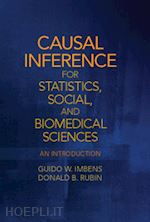
Causal Inference for Statistics, Social, and Biomedical Sciences An Introduction

;


Disponibilità: Normalmente disponibile in 20 giorni
A causa di problematiche nell'approvvigionamento legate alla Brexit sono possibili ritardi nelle consegne.


PREZZO
67,98 €
NICEPRICE
64,58 €
SCONTO
5%


Questo prodotto usufruisce delle SPEDIZIONI GRATIS
selezionando l'opzione Corriere Veloce in fase di ordine.


Pagabile anche con Carta della cultura giovani e del merito, 18App Bonus Cultura e Carta del Docente


Facebook Twitter Aggiungi commento


Spese Gratis

Dettagli

Genere:Libro
Lingua: Inglese
Pubblicazione: 04/2015


Trama

In this groundbreaking text, two world-renowned experts present statistical methods for studying causal effects: how can we learn about the expected effect of an intervention or a change in environment? The authors discuss how we can assess such effects in simple randomized experiments, where the researcher controls the treatments, and in observational studies, where the subjects themselves may affect which treatment they receive.


Note Editore

Most questions in social and biomedical sciences are causal in nature: what would happen to individuals, or to groups, if part of their environment were changed? In this groundbreaking text, two world-renowned experts present statistical methods for studying such questions. This book starts with the notion of potential outcomes, each corresponding to the outcome that would be realized if a subject were exposed to a particular treatment or regime. In this approach, causal effects are comparisons of such potential outcomes. The fundamental problem of causal inference is that we can only observe one of the potential outcomes for a particular subject. The authors discuss how randomized experiments allow us to assess causal effects and then turn to observational studies. They lay out the assumptions needed for causal inference and describe the leading analysis methods, including matching, propensity-score methods, and instrumental variables. Many detailed applications are included, with special focus on practical aspects for the empirical researcher.


Sommario

Part I. Introduction: 1. The basic framework: potential outcomes, stability, and the assignment mechanism; 2. A brief history of the potential-outcome approach to causal inference; 3. A taxonomy of assignment mechanisms; Part II. Classical Randomized Experiments: 4. A taxonomy of classical randomized experiments; 5. Fisher's exact P-values for completely randomized experiments; 6. Neyman's repeated sampling approach to completely randomized experiments; 7. Regression methods for completely randomized experiments; 8. Model-based inference in completely randomized experiments; 9. Stratified randomized experiments; 10. Paired randomized experiments; 11. Case study: an experimental evaluation of a labor-market program; Part III. Regular Assignment Mechanisms: Design: 12. Unconfounded treatment assignment; 13. Estimating the propensity score; 14. Assessing overlap in covariate distributions; 15. Design in observational studies: matching to ensure balance in covariate distributions; 16. Design in observational studies: trimming to ensure balance in covariate distributions; Part IV. Regular Assignment Mechanisms: Analysis: 17. Subclassification on the propensity score; 18. Matching estimators (Card-Krueger data); 19. Estimating the variance of estimators under unconfoundedness; 20. Alternative estimands; Part V. Regular Assignment Mechanisms: Supplementary Analyses: 21. Assessing the unconfoundedness assumption; 22. Sensitivity analysis and bounds; Part VI. Regular Assignment Mechanisms with Noncompliance: Analysis: 23. Instrumental-variables analysis of randomized experiments with one-sided noncompliance; 24. Instrumental-variables analysis of randomized experiments with two-sided noncompliance; 25. Model-based analyses with instrumental variables; Part VII. Conclusion: 26. Conclusions and extensions.


Autore

Guido W. Imbens is Professor of Economics at the Graduate School of Business, Stanford University. He has held tenured faculty positions at Harvard University, the University of California, Los Angeles, the University of California, Berkeley, and Stanford University. He is a fellow of the Econometric Society and the American Academy of Arts and Sciences. Imbens has published widely in economics and statistics journals, including Econometrica, The American Economic Review, the Annals of Statistics, the Journal of the American Statistical Association, Biometrika, and the Journal of the Royal Statistical Society.
Donald B. Rubin is John L. Loeb Professor of Statistics at Harvard University, where he has been professor since 1983 and department chair for thirteen of those years. He has authored or coauthored nearly four hundred publications (including ten books), has four joint patents, and has made important contributions to statistical theory and methodology, particularly in causal inference, design and analysis of experiments and sample surveys, treatment of missing data, and Bayesian data analysis. Rubin has received the Samuel S. Wilks Medal from the American Statistical Association, the Parzen Prize for Statistical Innovation, the Fisher Lectureship, and the George W. Snedecor Award from the Committee of Presidents of Statistical Societies. He was named Statistician of the Year by the American Statistical Association, Boston and Chicago chapters. He is one of the most highly cited authors in mathematics and economics with nearly 150,000 citations to date.


Altre Informazioni

ISBN:

9780521885881

Condizione: Nuovo
Dimensioni: 261 x 33 x 185 mm Ø 1280 gr
Formato: Copertina rigida
Illustration Notes:18 b/w illus. 97 tables
Pagine Arabe: 644


Dicono di noi