libri scuola books Fumetti ebook dvd top ten sconti 0 Carrello


Torna Indietro

börger egon; stärk robert - abstract state machines
Zoom

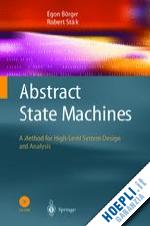
Abstract State Machines A Method for High-Level System Design and Analysis

;


Disponibilità: Normalmente disponibile in 15 giorni


PREZZO
54,98 €
NICEPRICE
52,23 €
SCONTO
5%


Questo prodotto usufruisce delle SPEDIZIONI GRATIS
selezionando l'opzione Corriere Veloce in fase di ordine.


Pagabile anche con Carta della cultura giovani e del merito, 18App Bonus Cultura e Carta del Docente


Facebook Twitter Aggiungi commento


Spese Gratis

Dettagli

Genere:Libro
Lingua: Inglese
Editore:

Springer

Pubblicazione: 04/2003
Edizione: 2003


Trama


The systems engineering method proposed in this book, which is based on Abstract State Machines (ASMs), guides the development of software and embedded hardware-software systems seamlessly from requirements capture to actual implementation and documentation. The method bridges the gap between the human understanding and formulation of real-world problems and the deployment of their algorithmic solutions by code-executing machines. Within a single conceptual framework it covers design, verification by reasoning techniques, and validation by simulation and testing. ASMs improve current industrial practice by using accurate high-level modeling and by linking the descriptions at the successive stages of system development in an organic and efficiently maintainable chain of rigorous and coherent system models at stepwise-refined abstraction levels. In several industrial projects the ASM method has proven its superiority compared to the popular UML methodology when designing complex parallel or dynamic systems.
This book combines the features of a textbook and a handbook: the reader will find detailed explanations, proofs, and exercises as well as numerous examples and real-world case studies. Researchers will find here the most comprehensive description of ASMs available today and professionals will use it as a "modeling handbook for the working software engineer." As a textbook it supports self-study or it can form the basis of a lecture course. Even more information can be found on the related website maintained by the authors: http://www.di.unipi.it/AsmBook/


Sommario

1 Introduction.- 1.1 Goals of the Book and Contours of its Method.- 1.1.1 Stepwise Refinable Abstract Operational Modeling.- 1.1.2 Abstract Virtual Machine Notation.- 1.1.3 Practical Benefits.- 1.1.4 Harness Pseudo-Code by Abstraction and Refinement.- 1.1.5 Adding Abstraction and Rigor to UML Models.- 1.2 Synopsis of the Book.- 2 ASM Design and Analysis Method.- 2.1 Principles of Hierarchical System Design.- 2.1.1 Ground Model Construction (Requirements Capture).- 2.1.2 Stepwise Refinement (Incremental Design).- 2.1.3 Integration into Software Practice.- 2.2 Working Definition.- 2.2.1 Basic ASMs.- 2.2.2 Definition.- 2.2.3 Classification of Locations and Updates.- 2.2.4 ASM Modules.- 2.2.5 Illustration by Small Examples.- 2.2.6 Control State ASMs.- 2.2.7 Exercises.- 2.3 Explanation by Example: Correct Lift Control.- 2.3.1 Exercises.- 2.4 Detailed Definition (Math. Foundation).- 2.4.1 Abstract States and Update Sets.- 2.4.2 Mathematical Logic.- 2.4.3 Transition Rules and Runs of ASMs.- 2.4.4 The Reserve of ASMs.- 2.4.5 Exercises.- 2.5 Notational Conventions.- 3 Basic ASMs.- 3.1 Requirements Capture by Ground Models.- 3.1.1 Fundamental Questions to be Asked.- 3.1.2 Illustration by Small Use Case Models.- 3.1.3 Exercises.- 3.2 Incremental Design by Refinements.- 3.2.1 Refinement Scheme and its Specializations.- 3.2.2 Two Refinement Verification Case Studies.- 3.2.3 Decomposing Refinement Verifications.- 3.2.4 Exercises.- 3.3 Microprocessor Design Case Study.- 3.3.1 Ground Model DLXseq.- 3.3.2 Parallel Model DLXpar Resolving Structural Hazards.- 3.3.3 Verifying Resolution of Structural Hazards (DLXpar).- 3.3.4 Resolving Data Hazards (Refinement DLXdata).- 3.3.5 Exercises.- 4 Structured ASMs (Composition Techniques).- 4.1 Turbo ASMs (seq, iterate, submachines, recursion).- 4.1.1 Seq and Iterate (Structured Programming).- 4.1.2 Submachines and Recursion (Encapsulation and Hiding).- 4.1.3 Analysis of Turbo ASM Steps.- 4.1.4 Exercises.- 4.2 Abstract State Processes (Interleaving).- 5 Synchronous Multi-Agent ASMs.- 5.1 Robot Controller Case Study.- 5.1.1 Production Cell Ground Model.- 5.1.2 Refinement of the Production Cell Component ASMs.- 5.1.3 Exercises.- 5.2 Real-Time Controller (Railroad Crossing Case Study).- 5.2.1 Real-TimeProcess Control Systems.- 5.2.2 Railroad Crossing Case Study.- 5.2.3 Exercises.- 6 Asynchronous Multi-Agent ASMs.- 6.1 Async ASMs: Definition and Network Examples.- 6.1.1 Mutual Exclusion.- 6.1.2 Master-Slave Agreement.- 6.1.3 Network Consensus.- 6.1.4 Load Balance.- 6.1.5 Leader Election and Shortest Path.- 6.1.6 Broadcast Acknowledgment (Echo).- 6.1.7 Phase Synchronization.- 6.1.8 Routing Layer Protocol for Mobile Ad Hoc Networks.- 6.1.9 Exercises.- 6.2 Embedded System Case Study.- 6.2.1 Light Control Ground Model.- 6.2.2 Signature (Agents and Their State).- 6.2.3 User Interaction (Manual Control).- 6.2.4 Automatic Control.- 6.2.5 Failure and Service.- 6.2.6 Component Structure.- 6.2.7 Exercises.- 6.3 Time-Constrained Async ASMs.- 6.3.1 Kermit Case Study (Alternating Bit/Sliding Window).- 6.3.2 Processor-Group-Membership Protocol Case Study.- 6.3.3 Exercises.- 6.4 Async ASMs with Durative Actions.- 6.4.1 Protocol Verification using Atomic Actions.- 6.4.2 Refining Atomic to Durative Actions.- 6.4.3 Exercises.- 6.5 Event-Driven ASMs.- 6.5.1 UML Diagrams for Dynamics.- 6.5.2 Exercises.- 7 Universal Design and Computation Model.- 7.1 Integrating Computation and Specification Models.- 7.1.1 Classical Computation Models.- 7.1.2 System Design Models.- 7.1.3 Exercises.- 7.2 Sequential ASM Thesis (A Proof from Postulates).- 7.2.1 Gurevich’s Postulates for Sequential Algorithms.- 7.2.2 Bounded-Choice Non-Determinism.- 7.2.3 Critical Terms for ASMs.- 7.2.4 Exercises.- 8 Tool Support for ASMs.- 8.1 Verification of ASMs.- 8.1.1 Logic for ASMs.- 8.1.2 Formalizing the Consistency of ASMs.- 8.1.3 Basic Axioms and Proof Rules of the Logic.- 8.1.4 Why Deterministic Transition Rules?.- 8.1.5 Completeness for Hierarchical ASMs.- 8.1.6 The Henkin Model Construction.- 8.1.7 An Extension with Explicit Step Information.- 8.1.8 Exercises.- 8.2 Model Checking of ASMs.- 8.3 Execution of ASMs.- 9 History and Survey of ASM Research.- 9.1 The Idea of Sharpening Turing’s Thesis.- 9.2 Recognizing the Practical Relevance of ASMs.- 9.3 Testing the Practicability of ASMs.- 9.3.1 Architecture Design and Virtual Machines.- 9.3.2 Protocols.- 9.3.3 Why use ASMs for Hw/Sw Engineering?.- 9.4 Making ASMs Fit for their Industrial Deployment.- 9.4.1 Practical Case Studies.- 9.4.2 Industrial Pilot Projects and Further Applications.- 9.4.3 Tool Integration.- 9.5 Conclusion and Outlook.- References.- List of Problems.- List of Figures.- List of Tables.


Altre Informazioni

ISBN:

9783540007029

Condizione: Nuovo
Dimensioni: 235 x 155 mm Ø 1780 gr
Formato: Copertina rigida
Illustration Notes:X, 438 p. With online files/update.
Pagine Arabe: 438
Pagine Romane: x


Dicono di noi