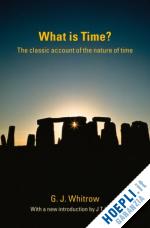
What is Time?
The classic account of the nature of time
whitrow g. j.
Disponibilità:
Non disponibile o esaurito presso l'editore
Genere: Libro
Lingua: Inglese
Editore: Oxford University Press
Pubblicazione: 03/2004
Trama
G. J. Whitrow (1912-2000) begins this classic exploration of the nature of time with a story about a Russian poet, visiting London before the First World War. The poet's English was not too good and when he asked a man in the street, 'Please, what is time?' he received the response, 'But<BR>that's a philosophical question. Why ask me?'. <BR>Starting from this simple anecdote, Professor Whitrow takes us on a good-humored and wide-ranging tour of the thing that clocks keep (more or less). He discusses how our ideas of time originated; how far they are inborn in plants and animals; how time has been measured, from sundial and hourglass<BR>to the caesium clock, and whether time possesses a beginning, a direction, and an end. He coaxes the diffident layman to contemplate with pleasure the differences between cyclic, linear, biological, cosmic, and space-time, and he provides frequent diversions into fascinating topics such as the<BR>Mayan calendar, the migration of birds, the dances of bees, precognition, and the short, crowded lives of mu-mesons, particles produced by cosmic-ray showers that exist for just two millionths of a second. <BR>This reissue of the classic and authoritative What is Time? includes a new introduction by Dr J. T. Fraser, founder of the International Society for the Study of Time, and a bibliographic essay by Dr Fraser and Professor M. P. Soulsby of the Pennsylvania State University. <BR>
Note Editore
In What is Time?, Professor Whitrow takes us on a good-humoured and wide-ranging tour of the thing that clocks keep (more or less). He discusses how our ideas of time originated; how far they are inborn in plants and animals; how time has been measured, from sundial and hourglass to the caesium clock, and whether time possesses a beginning, a direction, and an end. He coaxes the diffident layman to contemplate with pleasure the differences between cyclic, linear, biological, cosmic, and space-time, and he provides frequent diversions into fascinating topics such as the Mayan calendar, the migration of birds, the dances of bees, precognition, and the short, crowded lives of mu-mesons, particles produced by cosmic-ray showers that exist for just two millionths of a second.
Sommario
Dr J. T. Fraser: Introduction; 1: The Origin of Our Idea of Time; 2: Time and Ourselves; 3: Biological Clocks; 4: The Measurement of Time; 5: Time and Relativity; 6: Time, Gravitation and the Universe; 7: The Origin and Arrow of Time; 8: The Significance of Time; Appendix: Temporal Order in Special Relativity; Dr J. T. Fraser and Professor M. P. Soulsby: Bibliography; Index
Altre Informazioni
ISBN: 9780198607816
Dimensioni: 198x129 mm.
Formato: Paperback
Illustration Notes:numerous line drawings/ tables
Pagine Arabe: 186